
Build, for Glory is Coming (Haggai 2:1-9)
“The best is yet to be.” You may have heard of this saying, especially if it is the motto of a school you attended. Having gone to another school, my friends and I used to make fun of the motto, especially at inter-school competitions. The best is yet to be. Yes, that is why you are still not the best. Haha. But now that I am a lot older and a little wiser, I see the folly of my youth. There is truth in the saying, which is taken from the opening lines of a poem by Robert Browning:
Grow old along with me!
The best is yet to be,
The last of life, for which the first was made
Growing older can be challenging. Our bodies get weaker. Our minds get slower. But the poet Browning encourages us to embrace ageing as the culmination of life. But does this portrayal of old age sound too optimistic? Can we really say that the best is yet to be? It seems like our best years are behind us. Aches and pains are our daily companions, constantly reminding us that we are past our prime. Perhaps we are right to be sceptical about Browning’s poem. But the poem goes on to say this:
Our times are in His hand
Who saith “A whole I planned,
Youth shows but half; trust God: see all, nor be afraid!”
According to Browning, it is God who makes all the difference between wishful thinking and true hope. For apart from his plan, what assurance do we have of finishing well? But thanks to God, we need not be afraid of ageing. Our younger years do not give the full story. Only with age do we see God’s whole plan. So, rest assured. The ending will be better than the beginning.
The best is yet to be. This was the encouragement the temple builders needed to hear in Haggai’s day. After years of inaction, the rebuilding has resumed. But starting the work is the easy part. It is harder to keep going and finish well. The builders struggled with disappointment and discouragement. Will they be able to complete the work? And even if they do, will what they build actually count for much?
We can relate to this. We begin, but we do not always finish. Perhaps we look back with regret on dashed hopes, unfulfilled wishes, failed plans, or broken promises. We begin well, but things fall apart. Perhaps this is how we feel about growing older. We might also feel this way about the Christian life. We start with plenty of zeal, eager to serve Jesus. Then, life happens. We get busy, distracted or tired. Or, we are disillusioned by the difficulties and the apparent lack of results. Some of us may be struggling now with doubt, discouragement or disappointment. We are not sure if we have the stamina to make it to the finish line. Maybe we look back and think our best years are behind us.
God encourages the discouraged with His presence and promise.
What will keep us going until the end? How will we finish well? Our passage today encourages us to persevere in hope, trusting that the best is yet to be. Haggai 2:1-9 exhorts us to keep building, for glory is coming. This is the big idea: God encourages the discouraged with His presence and promise. We will work through these verses in two points: (1) Discouraged by faded glory; (2) Encouraged by future glory.
Discouraged by Faded Glory (Haggai 2:1-3)
As we heard from Haggai 1 last week, God urged his people to consider their ways and to put Him first. How can they let God’s house languish while they busy themselves building their own houses? Stirred up by God, the people hear and obey. They resume rebuilding the temple that was destroyed by the Babylonians almost 70 years ago. The timestamp in Haggai 1:15 tells us the work started “on the twenty-fourth day of the month, in the sixth month, in the second year of Darius the king”.
Haggai contains a number of timestamps, which highlight how God speaks to encourage His people during the first few months of rebuilding. In Haggai 2:1, we are given another timestamp: In the seventh month, on the twenty-first day of the month, the word of the LORD came by the hand of Haggai the prophet. About a month has passed since the rebuilding began. God speaks again. In Haggai 2:2, Haggai delivers God’s word to Zerubbabel the son of Shealtiel, governor of Judah, and to Joshua the son of Jehozadak, the high priest, and to all the remnant of the people.
God begins with searching questions that surface the people’s struggles. Look at Haggai 2:3 — “Who is left among you who saw this house in its former glory? How do you see it now? Is it not as nothing in your eyes?” God knows our discouragements and disappointments. He invites us to cast our burdens on Him. We can trust God to care for us while we build His house. He is a loving Father, not a harsh taskmaster.
The older Jews have lived long enough to see the splendour and majesty of the former temple before it was destroyed. That temple was dedicated by King Solomon, also in the seventh month. Describing that event, 1 Kings 8:10-11 says, “A cloud filled the house of the LORD... for the glory of the LORD filled the house of the LORD.” God is now speaking to the people in the seventh month. The timing is intentional, not coincidental. At a time when the people might be discouraged by memories of faded former glories, God speaks.
The Jews who remember the past would be greatly saddened by the present state of the temple. It is a pale shadow of what it used to be. The glory has departed. A similar sadness had also overcome the people when the temple foundations were rebuilt some years ago. Ezra 3:12 says, “Many of the priests and Levites and heads of fathers’ houses, old men who had seen the first house, wept with a loud voice when they saw the foundation of this house being laid.”
When the first temple was built, Israel was at the peak of its power. The wisdom of King Solomon and the wealth of his kingdom were the wonder of the world. When the queen of Sheba saw the temple, it took her breath away. But now, the king and kingdom are gone. The Jews have returned from exile, but they are still subjects of a foreign empire. And, as Haggai 2:2 says, only a remnant remains. The former temple was a worship magnet, drawing the nations to Jerusalem. By contrast, the present temple seems so insignificant. Zechariah 4 describes rebuilding the temple as a “day of small things”, nothing to write home about.
No doubt, the Jews are deeply discouraged as they ponder the present and the past. How might we also be disheartened when we compare our today with our yesterday? Some of us fondly remember our younger years and are discouraged by the challenges of growing older. Some of us are discouraged by how we have lost the spiritual zeal we used to have. Some of us fondly recall “the good, old days”, and we are discouraged by how things have changed. Or, we may be disheartened by what we see in the culture and society.
We may also be discouraged by the difficulties of building God’s house. As we heard last week, Jesus is the true temple. In him, we are God’s house. The church is the temple of the Lord. So, building God’s house means helping others to know and follow Jesus. It means building people up in Christ. But people are messy. We are broken and flawed. We struggle in many ways. We forget God’s word and stumble into sin. Our spiritual growth is slow and patchy. We face trials and temptations. We wrestle with sin and suffering. We offend and are offended by others. We have conflict and difficult relationships. Building people means walking with one another through the mess. In the church, we know first-hand the weaknesses and failures of God’s people. Often, the church’s faults are more glaring than its glory. The church seems so inconsequential. We are not exactly turning the world upside down. We read about past revivals in history, but our disciple-making is ordinary and unspectacular. Indeed, it looks like a day of small things.
We are to walk by faith, not by sight. Build God’s house, not because of what we can see now, but because of what we trust God to do in the future.
Not only is the work of rebuilding difficult, but it is also disappointing. The rebuilt temple will be inferior to the original one. The former glory has faded. As far as what the Jews can see, this house is as nothing in their eyes. God invites the people to acknowledge the sad reality of the situation. The people do not have to pretend they are not discouraged or disappointed. Being honest to God about our struggles helps to open our hearts to His grace. Our present difficulties should prompt us to look to God. How will we persevere in building God’s house? Do not simply look nostalgically on the past or dejectedly at the present. We are to walk by faith, not by sight. Build God’s house, not because of what we can see now, but because of what we trust God to do in the future.
Encouraged by Future Glory (Haggai 2:4-9)
In Haggai 2:4, God encourages Zerubbabel the governor, Joshua the high priest and the people: “Be strong... be strong... be strong”. God says it three times to drive home the encouragement. “Yet now” makes the point that they can be strong even in difficult circumstances. Do not give in to discouragement and disappointment. Notice also how the leaders and the people are addressed together — God calls all of his people to work together to build His house. In our context, God gives us pastors and elders to equip the rest of the church for ministry. We build together. One practical way of doing this is by taking part in the members’ meetings. We build God’s house when we, as fellow church members, affirm someone’s profession of faith and admit them into church membership.
So, be strong by looking to God. He is the LORD of hosts, the all-powerful, faithful, covenant-keeping God who commands heaven’s armies. We can be strong in the LORD because of His presence and His promise. God is present with his people. And, God has promised to glorify His house.
First: Be strong in the LORD because he is present with his people (Haggai 2:4-5). Look at the second half of Haggai 2:4: “Work, for I am with you, declares the LORD of hosts.” We can build God’s house with courage and confidence, for He is with us. We do not build alone or in our own strength. God is with us as we tell someone about Jesus. God is with us as we disciple one another to grow in the faith. God is with us as we help one another to fight temptation and sin. God is with us as we walk with one another through seasons of suffering and sorrow. God is with us as we seek to heal a hurt or reconcile a relationship.
“I am with you” recalls God’s words to Joshua encouraging Him to lead Israel into the promised land: “Be strong and courageous. Do not be frightened, and do not be dismayed, for the LORD your God is with you wherever you go.” (Josh 1:9) It also recalls David’s encouragement to Solomon his son to build the temple: “Be strong and courageous and do it. Do not be afraid and do not be dismayed, for the LORD God, even my God, is with you. He will not leave you or forsake you, until all the work for the service of the house of the LORD is finished.” (1 Chr 28:20). The God who encouraged His people in the past is also encouraging them in Haggai’s day. And, He is the same God who is still encouraging us today. Jesus has promised to be with us always, even to the ends of the earth.
We can be sure of God’s presence because it is founded on His faithfulness. He will keep His commitment to his people. Look at Haggai 2:5. God’s presence is according to the covenant that he made after the exodus from Egypt. God was with his people to save them from slavery, and he pledged to dwell among them. The tabernacle and the temple represented God’s presence with his people. But Judah broke the covenant and was sent into exile. The temple was destroyed, but God has not forsaken His people. Judah’s return from exile is proof of God’s grace and mercy. Although we are faithless, He remains faithful. If God has saved us by His Son, surely he will never leave us. God has bound Himself to us in a new covenant that cannot be broken, for it has been sealed with Jesus’ blood. And, Jesus has given us His Spirit, who guarantees our belonging to God. So, we need not fear, for the Spirit remains in us. The Spirit not only encourages us, but He also emboldens and empowers us to build God’s house. The early Christians in Acts spoke the word of God with boldness when they were all filled with the Holy Spirit. The Spirit gives us gifts to use to build up the church.
Second: Be strong in the LORD because he has promised to glorify his house (Haggai 2:6-9). God has a plan to do good to His people. The Jews of Haggai’s time did not have Solomon’s wealth. They had a tight budget and could not afford to build a temple as magnificent as Solomon’s. But our need is God’s opportunity. His power is made perfect in weakness. O that we would trust Him and not be anxious, especially about money!
God promises to work in wonderful ways for the glory of his house. He says in Haggai 2:6: “Yet one more, in a little while, I will shake the heavens and the earth and the sea and the dry land.” “Yet once more” tells us God has done great things for His people before, so we can trust Him to do it again! This previous shaking probably refers to the exodus, when the LORD redeemed His people by His power and gave them His word at Sinai. God says, “You thought that was impressive? Well, you ain’t seen nothing yet!”
So, be strong by looking forward in faith. Hope in what God says He will do. It will not be a small thing. No, God will shake all of creation for the glory of His name and for the good of His people. The best is yet to be. It will happen “in a little while”. It is coming soon. The Lord is never late, for he is not slow to fulfil his promise. So, do not lose heart. Be patient and wait for the Lord. It is as Peter says to suffering and hurting Christians: We are, by God’s power, being guarded for a salvation ready to be revealed in the last time. In this we rejoice, though now “for a little while”, we endure various trials.
The Jews were worried about running a budget deficit. How will they pay for the rebuilding? God assures them in Haggai 2:7-8: I will shake all nations, so that the treasures of all nations shall come in, and I will fill this house with glory, says the LORD of hosts. The silver is mine, and the gold is mine, declares the LORD of hosts. Do not be anxious and stop work. Go on building God’s house. The generous God will provide. After all, He owns everything we need! In the near term, God’s promise was fulfilled by the decree of the Persian king Darius, which is mentioned in Ezra 6. The rebuilding was paid for, courtesy of Persia’s royal treasury. Later on, Herod poured in His resources to expand the temple, doubling its size. The temple was very impressive. Jesus’ disciples were in awe of its stones and buildings.
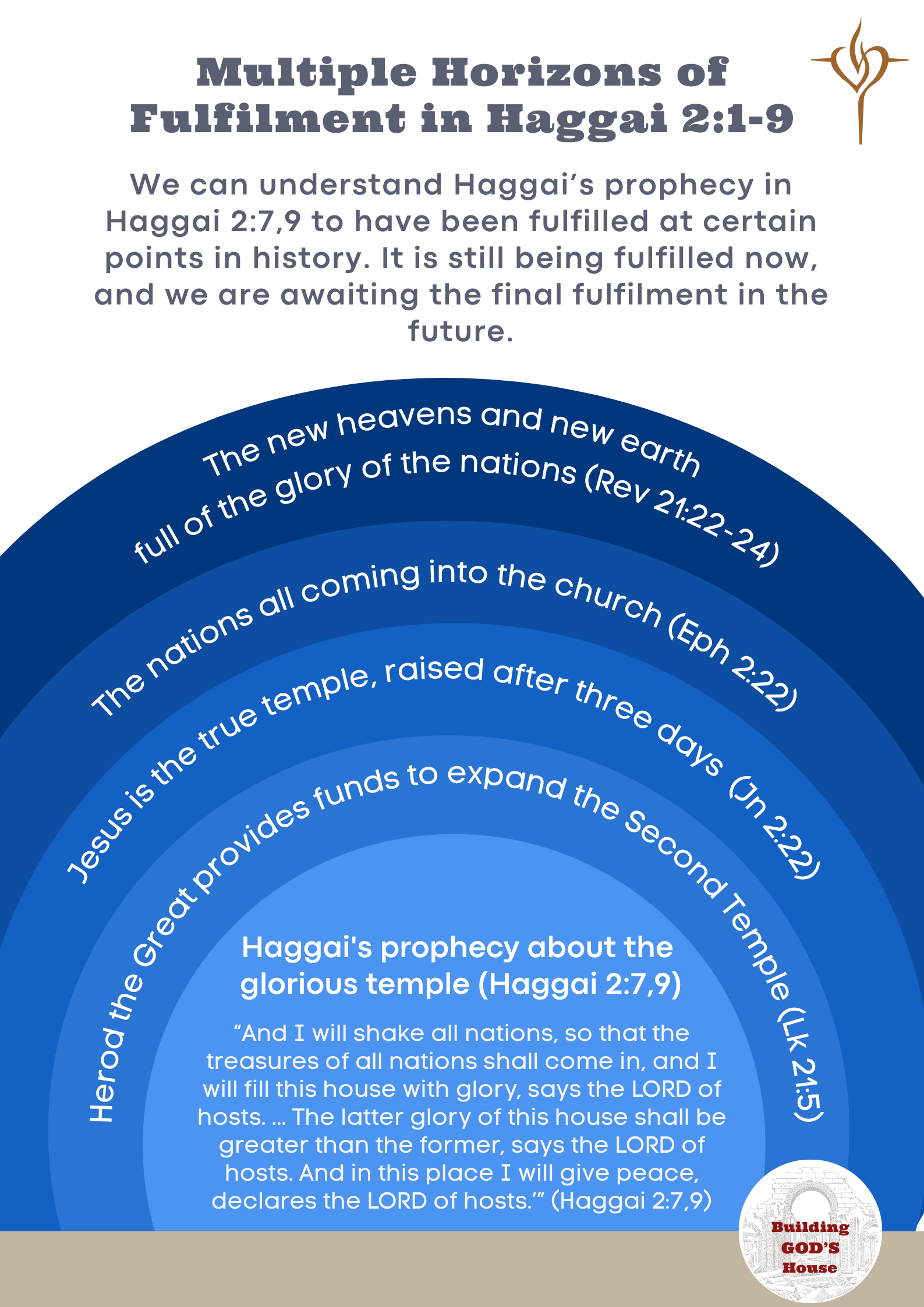
But Haggai’s prophecy points forward to a greater, grander fulfilment that cannot be matched by any earthly temple. Listen to Haggai 2:9: “The latter glory of this house shall be greater than the former, says the LORD of hosts. And in this place I will give peace, declares the LORD of hosts.” We look forward to the coming of the true temple, Jesus. He is far more glorious, for the fullness of God’s glory dwells in Him. Being fully God and fully man, Jesus has glory as the only Son from the Father, full of grace and truth. The Old Testament temple symbolised God’s presence, but Jesus is God with us. He has made God known to us, by coming in the flesh and living among us. Only in Christ can we know God. No one can come to the Father except by believing in the Son who reveals him.
We have all turned away from God who made us for his glory. Like Old Testament Israel, our hearts have not been faithful or thankful to God. We deserve God’s righteous judgement against us. But God, who is gracious and merciful, has sent His beloved Son to bring sinners back. Jesus laid down His life as a sacrificial offering to atone for sin. The temple of His body was destroyed when He died on the cross to bear God’s wrath against sinners. The true temple was then rebuilt in three days when Jesus rose from the dead. By trusting in Christ alone, we can be forgiven and brought back to God.
In Christ, we become a part of God’s house. Now that Jesus has come, His church is the temple. Not a physical building, but a spiritual house made of living stones — redeemed people gathered from every nation, language and culture. The glory of the church far exceeds that of Solomon’s temple, for we are a new creation, made alive in Christ and created for good works. God dwells in us by His Spirit. God displays His glory through His people. The church proclaims the unsearchable riches of Christ. Through the church, God makes known his wisdom, love, grace and power to all creation.
The church is the place where God has given peace through His Son. Jesus himself is our peace. He has reconciled us to God. He has also brought us together as one people, as fellow members of His church. The treasures of all nations have come into God’s temple because Christ has saved a people from every country, culture, tongue and tribe. We are a gathering of different ethnicities, nationalities, ages, and backgrounds. Because we have Christ in common, these differences no longer divide us. Do not put back the barriers Jesus died to tear down. Since Jesus has united us, we can love those who are different from us. This is how we glorify God.
Our relationships with one another will say something about Jesus. We either tell the truth about Him when we love and serve one another, or we lie about Him when we are quarrelsome, critical, unloving, unkind, and unforgiving towards one another. So, put away our anger, bitterness, gossip and strife. Do not grieve the Spirit who dwells in us. Be eager to maintain the unity of the Spirit in the bond of peace. Beloved, we are God’s temple. We have the awesome privilege of reflecting God’s glory to the world. Build God’s house by walking in love. Be imitators of God, as his beloved children. Blessed are the peacemakers, for they shall be called sons of God.
We can look forward to even greater glory.
We can look forward to even greater glory. The horizon of Haggai’s prophecy stretches further still. It is ultimately fulfilled when Jesus returns to usher in the new heavens and new earth. Hebrews 12:27 says, “This phrase, ‘Yet once more,’ indicates the removal of things that are shaken — that is, things that have been made — in order that the things that cannot be shaken may remain.” In Christ, we have received a kingdom that cannot be shaken. When Jesus returns, He will glorify the church by raising us up together with Him. We shall see His face and share in His glory.
When I lived in the US and was looking to buy a home, I came across a category of properties known as “fixer-uppers”. A fixer-upper is a house that is a lot cheaper because it needs significant rebuilding and renovation. Buyers typically have two kinds of responses to fixer-uppers. The first just sees a house that is falling apart and not worth the money. But the second response is to look beyond what we see now. It is to look with imagination, and see how beautiful a rebuilt house can be. When we realise what matters is not the state of the house now, but what it will be, we will invest in it.
God has bought a fixer-upper — the church. Based on what our eyes can see now, the church does not look very impressive. Many things need fixing. Flaws, faults and failures are everywhere. This can be discouraging. We might want to stop work and throw in the towel. But God, through the prophet Haggai, encourages us to keep building, for greater glory is coming. Do not lose heart. Do not let our present trials and troubles make us forget the hope we have in Christ. He has already defeated sin and death. When we build His house, we are building something more glorious and more lasting than what we can see now. Beloved, what we will be has not yet appeared but we know that when our Lord and Saviour appears we shall be like Him, for we shall see Him as He is. Jesus is coming back. He will right all the wrongs and make all things new. He will build His house and glorify His church. In the Lord, our labour is not in vain. God has graciously given us a glimpse of this greater glory: “And I saw no temple in the city, for its temple is the Lord God the Almighty and the Lamb. And the city has no need of sun or moon to shine on it, for the glory of God gives it light, and its lamp is the Lamb. By its light will the nations walk, and the kings of the earth will bring their glory into it.” (Rev 21:22-24)
So, build because of what Jesus can and will do. Build with an imagination fuelled by the hope of the gospel. We need gospel imagination if we are to be bold, take risks, and make sacrifices to follow Jesus. In the words of pioneer missionary William Carey: Expect great things from God. Attempt great things for God. So, build by faith that the best is yet to be. Build, for greater glory is coming.